By Andreea Gatman, Act On Learning
Teaching and learning as petitioning
A 10*20 Petcha Kutcha
Abstract
This concise article introduces the three-year training component of ODDience2030 through an artful PechaKucha, ”10 images, 20 seconds each”, framed as a five‑question petition for sustainable education. Guided by the question “What is your local ecology?”
The narrative traces how with a multicultural cohort of 64 teachers in France, Finland, India and Portugal, we proposed a practice‑based methodology that makes SDG learning an everyday classroom reality.
Phase 1 (Foundation: Ecology Leadership in the Classroom) cultivates five interior teacher competencies through coaching circles and simple, repeatable tools, emphasising pedagogical relationships.
Phase 2 (Prototyping) accelerates integration via dyads/triads and peer circles, generating 18 classroom prototypes and tracking change with ODDience2030 GRIDS for critical thinking and creativity.
Phase 3 (Campfire) convenes students, teachers, NGOs, and artists in a youth social arts program to strengthen witnessing capacity, authenticity, and “togetherness pedagogies” term coined by the work of Dutra&Hayashi. Across the five questions—title, solution, urgency, why sign, and a closing invitation—we argue for teaching as connection rather than partitioning, for creative time amid curricular urgency, and for local ecologies as gateways to planetary responsibility.
In this article the PechaKucha format serves both as method and message: a concise, evocative petition that documents how teachers and students co‑create meaning, sustain attention, and leave learning after the lesson is over.
1st Question: What is the title of our petition?
“So what is your local ecology?” asks Judy Meyer, K–12 Education/Outreach Senior Program Coordinator at the McDonald Observatory, University of Texas. The question became foundational as we prepared to open the teachers’ training foundation program—Ecology Leadership in the Classroom—and the first phase of the ODDience2030 training methodology. The work would unfold in a multicultural context with 64 teachers from France, Portugal, Finland, and India. Meyer continues: “Ours is the dark, dark sky” (2023).
Why do we need dark? To study the light. By exploring the light from stars, we discover secrets about our universe (McDonald Observatory, Texas).
In ODDience2030, our local ecology is sustainable education: students and teachers care about what they do in the classroom; by care we mean it matters. When it matters, they create matter—the realities they want to see as more sustainable futures, more sustainable lessons (O’Brien, 2021). In the Foundation program (Year 1), teachers work with five interior competencies through clinical education (coaching circles) and simple instruments for everyday class. We allow time for the pedagogical process at the core of sustainable education : learning relationships leave to teach another day (Kimmerer, 2024).
2nd Question: What is the solution—what future would we like to see?
Connections
Connect the five interior conditions of the teacher (competencies) to practice. Notice small changes in peer practices through dyads, triads, and peer circles organized every two weeks in each of the four partner schools. Accelerate, apply simple tools from the Foundation program in real classes and iterate. Prototype, 18 classroom prototypes across the four countries that make sustainable education an everyday reality. Assess: use ODDience2030 GRIDS for critical thinking and creativity to track change at self, class, and community levels.
Teaching as the joy of not being alone. Mainstream teaching—also when approaching the SDGs—often partitions learning (Sertillanges, 1932), subtracting the subject from the whole, leaving teachers “lonely wolves” (Lonka, 2018). Through reflection, new perspectives, and open questions from their subjects, teachers reconnect curriculum to real life. Continuing the constellation metaphor, teachers “leave students learning after the lesson is over.” With an Integrative Curriculum approach, developed in Phase 2 (Year 2: Prototyping), integration made everything easier: students’ minds grew more receptive, approached the center (the subject and specific SDG understandings) through multiple paths. The ODDience2030 assessment grids allowed us to document these changes—across 4 countries, and the 18 prototypes.
3rd Question: What is the urgency—what happens if we do not teach with SDGs in everyday lessons?
The SDG vision builds a more connected world, with equal distribution and social justice, and access to sufficiency within planetary boundaries.
Disconnection from Self, Other, and Place leaves students and teachers unable to connect curriculum to real life—a weakening of contemporary witnessing capacity (Hübl, 2024). When that connection is missing, we miss learning opportunities and the developmental gains that come from tackling complex, wicked challenges. Phase 3 of the ODDience2030 training component was structured as a youth social arts program—Campfire—delivered over three days in Lapland, Finland. Seventeen high‑school students from the four participating countries, nineteen teachers, NGOs in sustainability, and artists gathered. In Campfire, a “box” with elementals didactics, resources, and learning cards moved us through the emotional stages behind creativity and into local ecologies, ecosystems, and ecotones—until a perceptual shift occurred. Through material engagement and in the presence of compassionate adult teachers and environmental experts, youth incrementally created what O’Brien calls a field of resonance. Four boxes—unpacked and repacked—supported students to work from authenticity, communicating not only across the country groups present but also to wider public audiences at home through Social Artifacts. Social arts pedagogies, as a “togetherness pedagogy,” make visible the quality of attention, clarify learning in the company of others, and document how learning happens. This process is also a source of well‑being for youth and teachers and merits further exploration in Erasmus projects.
4th Question: Why should you sign—why offer attention?
Beyond the rushed, 45‑minute lesson cadence of school timetables, we cultivate pedagogies for creative time. Teaching and learning with the SDGs invite complex, wicked problems where students and teachers develop the competence of creative time (Bergson, 1907). Linda Hill’s work at Harvard clarifies this in practice as the capacity to hold urgency to act while sustaining a “there is plenty of time” quality of attention.
In the three‑day Campfire program, seventeen students from four countries, working through four elemental perspectives and at least ten cultural systems, explored their local ecologies. Through social arts, they also witnessed and supported other groups’ ecologies, a togetherness pedagogy (Dutra & Hashasi, 2025). This is why we ask you to sign: to uphold the conditions—time, attention, connection—that fosters sustainable education take root as everyday lessons.
5th I would still like to tell you…
There are learning ergonomics—places and formats that hold the potentiality of teaching and learning with SDGs as everyday lessons more than others. We can grow our local ecologies there until our local ground is ready, as a global support network for local action (Actonlearning).
Gratitude to the mentor guests and international experts who generously supported the ODDience2030 training methodology for sustainable education as everyday lessons:
Alexandra Sargent Capps, textile artist and professor, FabLab Director at the Wond’ry Innovation Center, Vanderbilt University—resourcefully decoding process, guiding the Social Artifact installation in Campfire, and mentoring fast‑fashion SDG‑related prototypes.
Carol Williams, PhD, ecologist and researcher, Project Director at the University of Wisconsin—for over a year of companionship, bridging ecological knowledge and translating it into cross‑cutting competency processes for Campfire. Dr. Williams artfully integrated ecological expertise into five integrative practices that support the five key interior competencies of the Foundation program.
Shashi Nair, co‑initiator of the Wellbeing Movement Lab, India—sharing prototyping methodologies and serving as an insightful prototype mentor for ODDience2030.
H.D. McKay, librarian and community engagement expert at Vanderbilt University—offering the Polarities game, which ODDience2030 teachers adapted into classroom prototypes.
Prof. Christina da Silva Iddings—sharing her teacher‑preparation expertise and supporting the acceleration training with the eLAB program organized in March 2025.
Milestones at a glance
In the three‑day Campfire program, seventeen students from four countries, working through four elemental perspectives and at least ten cultural systems, explored their local ecologies. Through social arts, they also witnessed and supported other groups’ ecologies, a togetherness pedagogy (Dutra & Hashasi, 2025). This is why we ask you to sign: to uphold the conditions—time, attention, connection—that fosters sustainable education take root as everyday lessons.
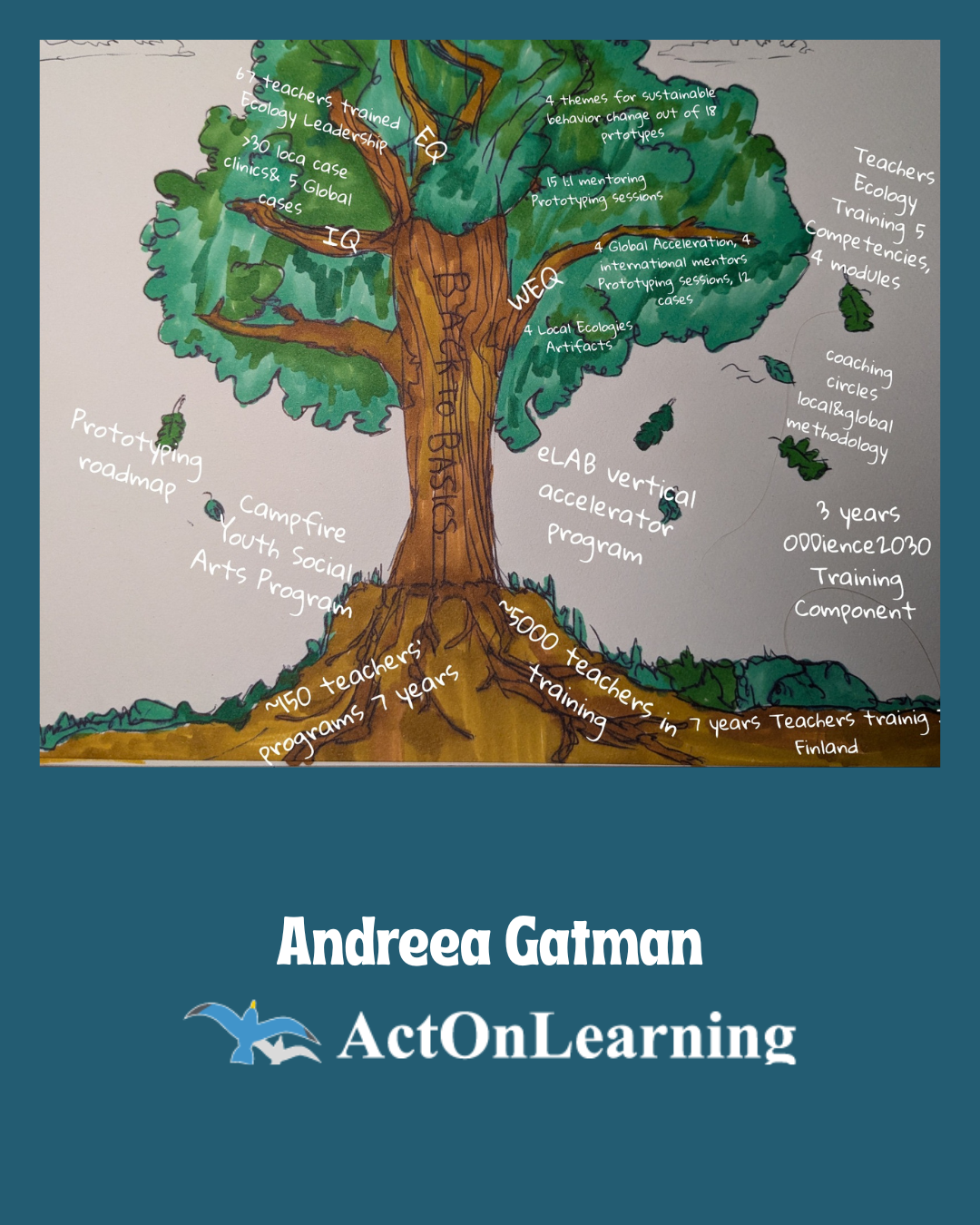
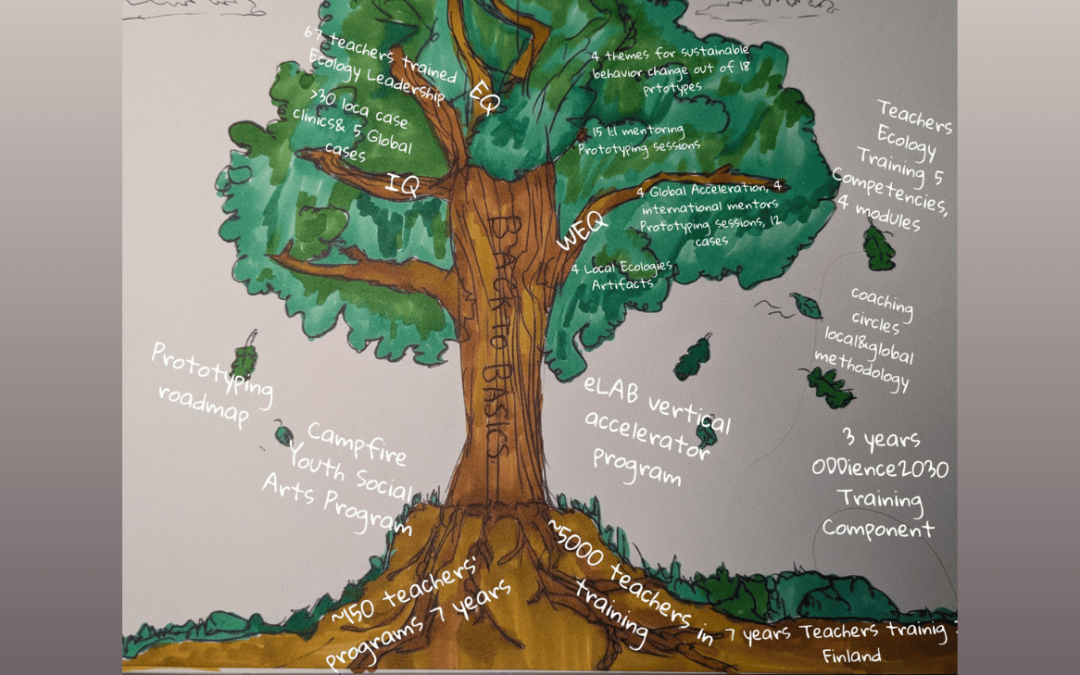
Phase 1 (Year 1): FoundationEcology Leadership in the Classroom: 64 teachers across 4 countries (France, Portugal, Finland, India) five interior competencies; over 50 case clinics in coaching circles; simple classroom instruments; peer circles every two weeks in 4 partner schools
Phase 2 (Year 2): Prototyping—4 shared values for 18 classroom prototypes; 15 1:1 mentoring sessions, 4 Global Acceleration meetings and 1 onsite Vertical accelerator program addressing the 4 most probable behaviour changes; assessment with ODDience2030 GRIDS for critical thinking and creativity
Phase 3 (Year 3): Campfire—3‑day youth social arts program in Lapland; 17 high‑school students; 19 teachers; 4 Social Artifact boxes; cross‑country public communication